White label prediction markets: your brand, your wallet, our markets
White label should mean your customer never meets a second brand, a second login or a second balance. Here is what of a prediction markets product can carry your brand, how it reaches your product, and what stays yours throughout.
In this article 9 sections
- What white label prediction markets should mean
- Your brand: what you can set
- Theming per operator, placement and customer
- Your wallet: one balance, one ledger
- Our markets: what runs behind the surface
- How it is delivered: embed or API
- From provisioning to a live tab
- What white label does not change
- Questions to ask a white label provider
White label prediction markets put a complete prediction markets product inside your sportsbook, casino or app under your own name: the market list, the ticket, the positions and the early exit, in your colours, your language and your wallet. A provider runs the catalogue, the pricing, the execution and the settlement behind it, and your customer never meets a second brand.
The term is used loosely, so it is worth pinning down what it should mean for an operator, how it reaches your product, and exactly what Parity's version does and does not let you change.
What white label prediction markets should mean
Three things, in this order of importance.
- Your customer
- The customer signs in to your product and nowhere else. Your server maps a customer you have already authenticated to a session; Parity never authenticates your customers, never sees a credential and never contacts them.
- Your wallet
- Stakes and payouts move on the balance the customer already has. There is no transfer step, no second balance and no provider withdrawal screen.
- Your brand
- The surface renders inside your product, with no redirect to another domain and no second sign-in, in your colours and your language.
If a provider needs your customer to open a second account or fund a second balance, it is not supplying infrastructure. It is asking you to send customers to its product.
Your brand: what you can set
On Parity, branding is four settings, stored on your operator.
- Mode
- Light, dark, or inherited from the page around the frame.
- Accent
- Your accent colour as a hex value. The text on it is chosen automatically for contrast.
- Radius
- Sharp, soft or round corners.
- Density
- Comfortable or compact spacing.
There is no font or logo setting, deliberately. The frame inherits the page around it rather than redrawing your brand inside it, which is why it reads as part of your product instead of a panel from somewhere else. A short, exact list is worth more than a promise that everything is customisable, because you can check it before you sign. The same list sits on the white label prediction markets page, beside a picture of the surface on a phone.
Theming per operator, placement and customer
Every presentation setting has a default stored on your operator. A single placement can override it on the frame's address, a customer's session can carry its own, and your page can change the theme live with one message, without a reload. The most specific instruction wins.
Language and region work the same way. The surface speaks English, Spanish, Portuguese and Croatian, chosen per placement, per customer session or as your operator default. A region setting orders the board so the markets your customers care about lead, and stakes are shown in your operator's display currency, converted only through a peg or a recorded rate. A group running brands in several countries can launch each one as configuration rather than a new project, which launching prediction markets in more than one country takes further.
Your wallet: one balance, one ledger
White label that stops at the screen is not white label. Parity never holds your customer funds. Your wallet stays the single authoritative balance, and Parity returns the exact amounts to reserve, debit, release and credit, as decimal strings, for your ledger to apply. Parity is told only whether the reserve succeeded.
A resolved event arrives at your webhook as a settlement record, signed, retried and safe to apply twice without paying a customer twice, and two reconciliation endpoints let you check your books against ours. Prediction markets on one wallet sets out the whole money path.
Our markets: what runs behind the surface
- The catalogue
- Continuously ingested and normalised: each event one question with priced outcomes, its price history and its resolution rules, across sports, politics, economics, finance, crypto, technology, weather, culture and more.
- Pricing and execution
- Live prices, executable quotes with an expiry, and an order refused rather than filled at a worse price when the market has moved.
- Positions
- Marked against the live price continuously, with an exit before resolution at a market price.
- Settlement
- Decided on the published resolution rules attached to each contract, and reported to your ledger exactly once.
- Your offering
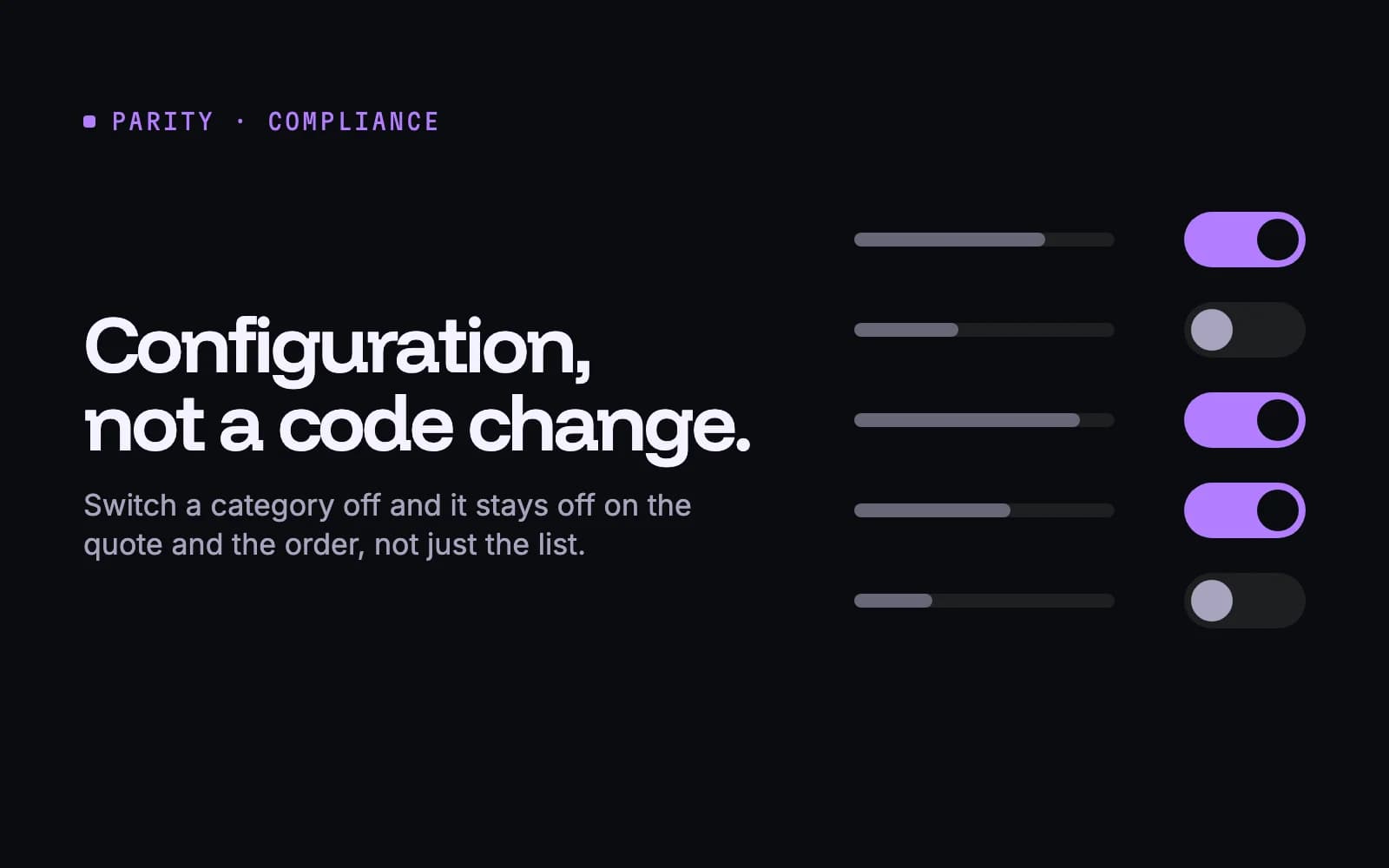
- Which categories your customers see, set per operator and per customer, and enforced on the catalogue, the quote and the order.
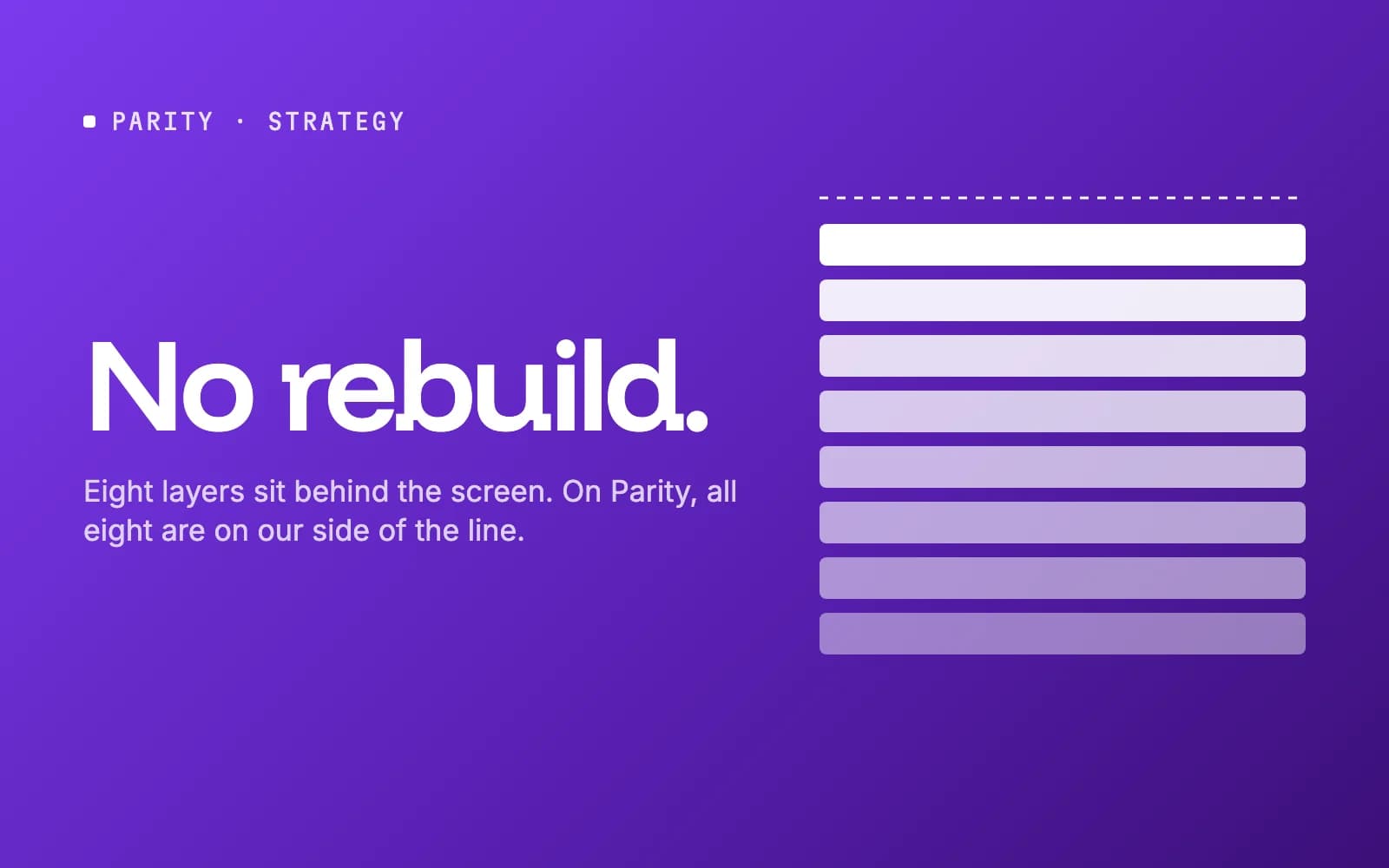
Those are the layers any prediction markets software has to own for your side of the integration to stay small.
How it is delivered: embed or API
There are two shapes on one account, and the line between your side and ours is the same in both.
The embedded surface is where most operators start. Your team builds three things: a server endpoint that mints a session for a signed-in customer, the frame on the origins you register with a message listener on your page, and a webhook for settlement. Parity draws the market list, the ticket and the positions. An origin you have not registered cannot render the surface at all.
The API is white label in the strictest sense. Prices, positions and settlement records come back as data, so everything your customers see is rendered by you and carries your brand alone. It suits a team that would rather draw every pixel, and the prediction market API sets out what it returns.
From provisioning to a live tab
- Provisioning
- Your operator is set up with credentials, your stored theme and language, and the origins your frame may render on.
- A session for each customer
- One server-to-server call maps a signed-in customer to a session and returns a browser-safe token.
- The surface, in your colours
- The market list, the ticket and the positions render inside your app, with no redirect and no second sign-in.
- Money on your ledger
- Stakes and settlement move as exact amounts your wallet applies, and the customer keeps one balance.
You build against a sandbox first, one that can be driven to outcomes that have not happened yet, and move to production once the integration passes the going-live checks. The embed documentation has every field.
What white label does not change
Your licence, your KYC and AML, your responsible-gaming controls, your support and the decision about who may see the vertical all stay with you. Where the final allocation of KYC, custody and regulatory responsibility falls is a commercial and legal question per jurisdiction, and it belongs at the start of the project rather than the end. Prediction market compliance by country frames it.
Questions to ask a white label provider
Does my customer sign in anywhere but my product? Is there a second balance anywhere in the money path? Exactly which parts of the surface can I brand, and where is that written down? Can I set language, region and theme per placement and per customer? And when a market settles, how does the record reach my ledger exactly once?
White label prediction markets answers each of those for Parity, with the launch steps and the responsibility split in full. The House Money case study shows the embedded surface inside an operator's own casino, and if you run a platform for agents and their players, prediction markets for your players shows the same product as a tab in the client area you already run.