Launching prediction markets in more than one country
An operator in several markets cannot run one catalogue in one language with one set of rules. Each country needs its own language, its own currency display and its own view of what may be offered.
In this article 4 sections
An operator licensed in more than one market has a problem a single-country launch never meets. The same customer journey has to speak Spanish in one place and Portuguese in another, lead with local markets, show stakes in local money, and respect a different list of what may be offered in each jurisdiction. If the prediction-markets vertical cannot do all of that from one integration, the operator ends up running one integration per country.
What changes from country to country
- Language
- A Brazilian customer and a Croatian customer should each see the market list, the ticket and the positions in their own language, without a separate build.
- What leads the board
- Local elections, local economics and local sport should be first on the screen where they matter, not buried behind somebody else’s headlines.
- Currency
- Stakes and payouts should read in the money the customer deposited, converted on a rate you can stand behind.
- What may be offered
- A category your licence permits in one jurisdiction may be off limits in the next, and the switch has to hold at the order, not only on the list.
How Parity handles each one
- Four languages
- English, Spanish, Portuguese and Croatian, chosen as your operator default, per placement, or per customer session. A Brazilian Portuguese session reads as Portuguese.
- Ten regional boards
- A region setting orders the board so the markets your customers care about lead: global, Argentina, Brazil, Mexico, Chile, Colombia, Peru, the United States, the EU and Croatia. It can be set per operator, per placement or per customer.
- Your display currency
- Stakes are shown in your operator’s display currency, converted only through a peg or a recorded rate, never an estimate.
- Rules per jurisdiction
- Your server can record where you say each customer is, by country and, where it matters, by state or province. That is what decides a jurisdiction-enforced offering, and it is enforced on the catalogue, the quote and the order alike.
One integration, several markets
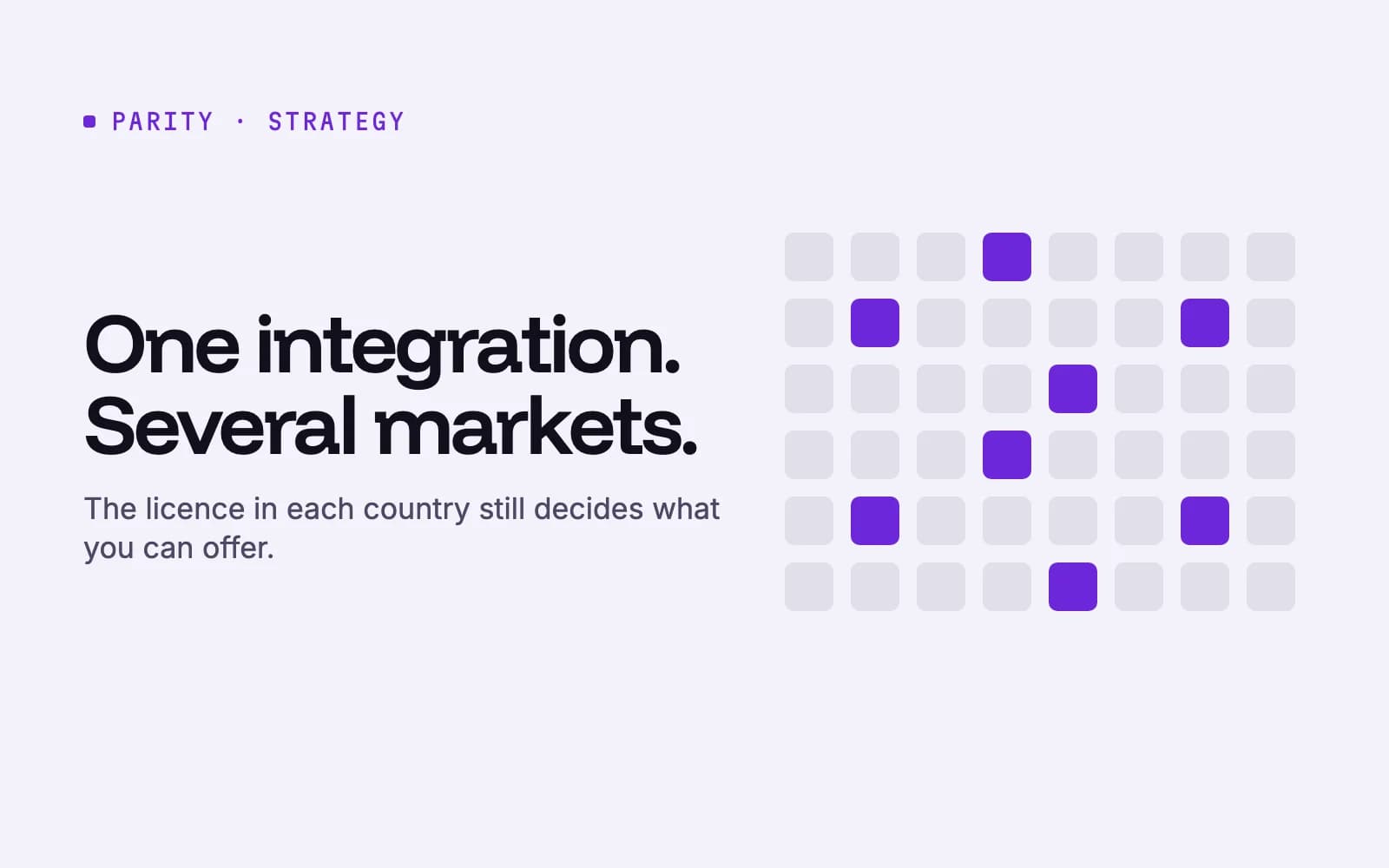
Every presentation setting has a stored default on your operator and can be overridden for a single placement or a single customer, and the most specific instruction wins. That means a group running brands in several countries can launch each market as a configuration change rather than a new project: the session endpoint, the iframe and the settlement webhook stay the same.
The licence still decides
None of this settles whether you may offer a category in a given country. That is a question for your licence and your counsel, and the regional rules apply what you decide rather than encoding any law. Prediction market compliance by country sets out how to frame it, and controlling which markets your customers see covers the rules themselves. What the surface looks like in your brand is on white label prediction markets.