For casino operators
Prediction market platform for online casinos
New wagering inventory for the players you already have.
Prediction markets as a category inside your casino: on your brand, on your wallet, on your licence. You keep the customer and the balance; Parity runs the catalogue, the pricing, the execution and the settlement behind the surface.
The proposition
A different product on the same wallet.
A casino's inventory problem is not that there are too few slots. It is that every title competes for the same session, with the same mechanics, against the same alternatives. It is also that a player with an opinion about an election, a rate decision or the price of Bitcoin has nowhere in your product to express it.
Prediction markets are that somewhere. They are a genuinely different wagering shape: priced by a market rather than set by a house, held as a position that can be exited before it resolves, and settled against a published outcome the player can go and check. What they are not is a new platform, a new wallet or a new account.
It opens where your players already are.
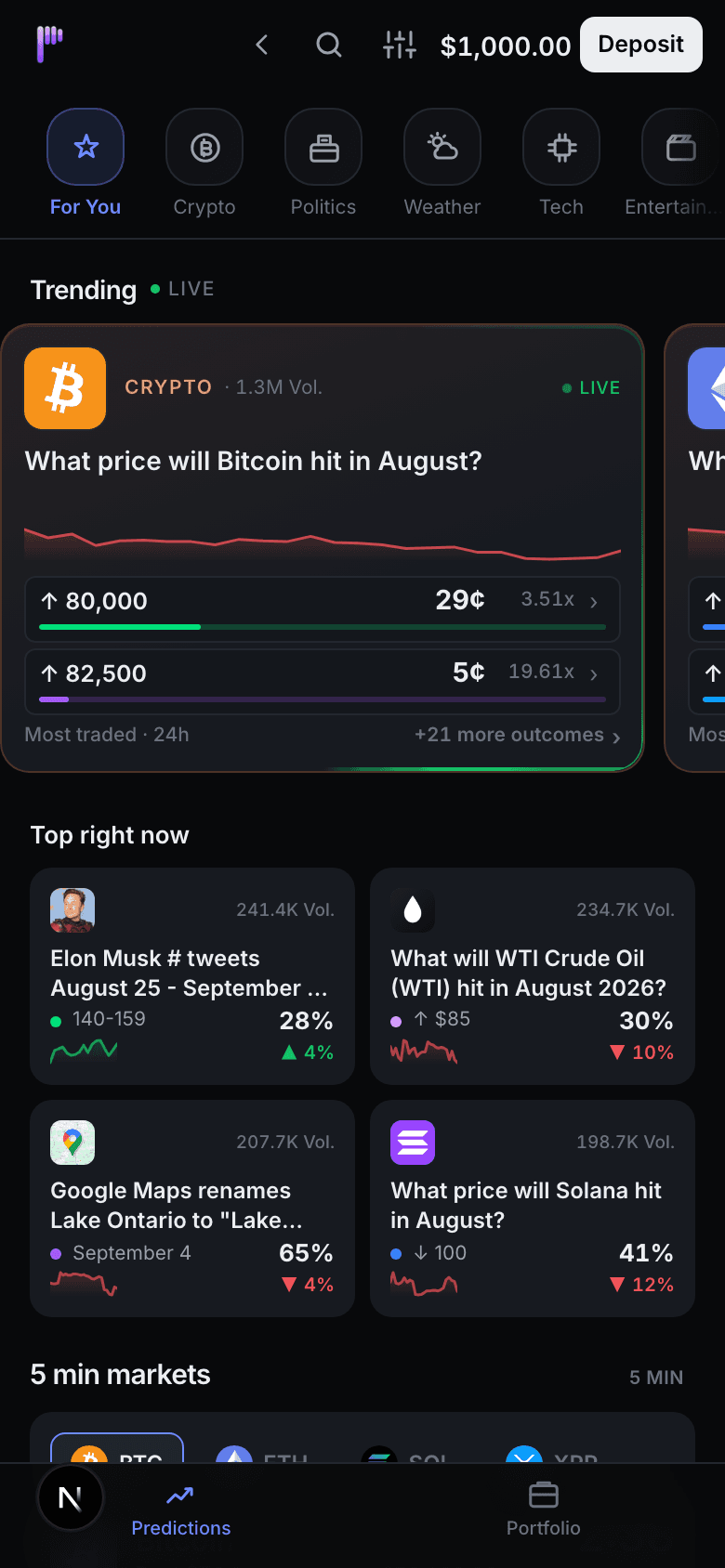
The surface Parity draws is the product Parity invests in: the market list, the ticket, the positions, the early exit, the localisation and the mobile layout. It is the same surface on a phone as on a desktop, and it wears your colours rather than ours.
Your team's work is a session endpoint and a message listener. Nobody on your side writes a market renderer, a price stream client or a settlement translator. That is why this is a small project rather than a platform build.
How to add prediction markets to an online casino walks the same ground for a technical reader.
The launch
What actually happens, in order.
- 01
You are provisioned as an operator
A tenant, credentials, and the origins your frame is allowed to render on. An unregistered origin cannot render the surface at all, which is the first of several controls that exist so a leaked key is not a product. - 02
Your server mints a session for a signed-in player
One server-to-server call maps your customer to a Parity session and returns a browser-safe token. Parity never authenticates your players, never sees their credentials and never contacts them. - 03
The Predictions surface renders inside your product
Market list, ticket and positions, on your brand, in your app. Your team writes a message listener, not a trading interface. If you would rather build the front end yourself, the same account can drive the API directly. - 04
Stakes move on your ledger, and only on your ledger
Parity returns the exact amounts to reserve, debit, release and credit. You apply them. There is no transfer step, no second balance and no Parity withdrawal screen. The player's money never leaves the balance you already hold for them. - 05
Settlement is reported back to you
A resolved event becomes a settlement record delivered to your webhook endpoint, safe to apply twice without paying a customer twice, with two reconciliation endpoints for checking your books against ours.
The boundary
You keep the customer. Parity keeps the market infrastructure.
The line is drawn once and it does not move between integration modes. Where the final allocation of KYC, custody and regulatory responsibility falls is a commercial and legal question per jurisdiction, and this page does not settle it.
Your casino
- Player accounts, sign-in and sessions
- Deposits, withdrawals and the one cash balance
- KYC, AML and responsible-gaming controls
- Brand, app, support and who may see the vertical
- Your licence and your jurisdictional footprint
Parity
- Market catalogue, normalisation and categories
- Live pricing and the embedded surface
- Quotes, orders, execution orchestration and fills
- Positions, marks and early exit
- Settlement, reconciliation and the exact money instructions
The full version of this split, including what crosses the boundary and what never does, is on embedded prediction markets.
Objections
The five questions every operator asks.
- Does the player leave my product?
- No. The surface renders inside your app on your brand. There is no redirect to a Parity domain, no second sign-in and no co-branded landing page in the middle of the journey.
- Do I need a second wallet?
- No, and this is the part worth reading twice. A player with $100 in your casino wallet who stakes $25 on a market still has one balance of $100: $75 available and $25 reserved. Parity is told only whether the reserve succeeded.
- Who owns the customer?
- You do: the account, the KYC, the deposits and withdrawals, the responsible-gaming controls, the support conversation and the decision about which players may see the vertical at all.
- What does my team actually build?
- A server endpoint that mints a session, the frame, and a webhook endpoint for settlement. Catalogue, pricing, quoting, execution, position rendering, early exit, resolution and reconciliation sit on the Parity side of the line.
- Is this my sportsbook?
- No. Sports markets are available as one category among many, and you choose which categories your players see: sports can be switched off entirely or narrowed to the sports you want, and the rule holds on the catalogue, the quote and the order. How prediction markets sit beside a book covers that in full.
The customer's money stays in the single balance you already hold. There is no “transfer to Predictions” step, and there never will be.
Proof
One operator, documented end to end.
There is one live embedded operator integration and this is it. The case study shows exactly how it is wired, and the only figures in it are the ones House Money reported about its own platform.
Current state
What runs today.
Running today
- The embedded surface, provisioned per operator and origin
- A continuously ingested catalogue with prices, history and resolution rules
- Sports as one category among many, switched on or off per operator and per sport
- Positions, marks, early exit and settlement reporting
- English, Spanish, Portuguese and Croatian with regional ordering
The demo on this site is the practice surface. It prices against live markets, but its fills are simulated and nothing placed in it reaches a venue. An operator deployment is a different thing: its orders can route to live venues through Parity's execution layer, which is enabled per operator at go-live and checked on every order before it is sent.
Questions
What casino operators ask before they integrate.
How much work is a casino integration?
A session endpoint, the frame with a message listener, and a settlement webhook. Catalogue, pricing, execution, positions, early exit, resolution and reconciliation sit on the Parity side of the line, which is what makes it a small project rather than a platform build. You build against a sandbox first and move to production once the integration passes the going-live checks.
How does licensing work for an online casino?
Prediction markets run as a category inside your casino, on your licence, with your accounts, KYC and responsible-gaming controls unchanged. Where the final allocation of KYC, custody and regulatory responsibility falls is a commercial and legal question per jurisdiction. Tell us which jurisdictions you hold and what your licence permits, and we will tell you what is available to you.
How is Parity priced for a casino?
Per integration. Your rate is set by the volume you run through it and by what you take: the normalised catalogue, quotes and execution, positions and settlement, the embedded surface and the five-minute crypto markets. Talk to us and we will put a number against your integration.
How do winnings reach the player's balance?
When an event resolves on the published rules attached to the contract, Parity sends a settlement record to your webhook endpoint with the exact amount to credit, and your ledger applies it. The player is paid into the same balance they staked from. The record is signed, retried and safe to apply twice without paying anybody twice, and two reconciliation endpoints let you prove your books and ours agree.
Can the prediction markets be white labelled to my casino?
Yes. The surface renders inside your product, with no redirect to a Parity domain and no second sign-in. You set its mode, accent colour, corner radius and density, it speaks English, Spanish, Portuguese and Croatian, and it inherits your page around it rather than redrawing your logo.
Can a player exit a position before the event resolves?
Yes. A position is marked against the live price continuously and can be exited before resolution. The exit executes at a market price, not at a cash-out figure a house chose to offer.
Which markets will my players see?
Events from a continuously ingested catalogue: sports, politics, economics, finance, crypto, technology, weather, culture and more, each with its price history and resolution rules. You decide which categories reach your players, sports included, per operator and, if you need it, per player, and the rule is enforced on the catalogue, the quote and the order alike.
Read next
White label
White label prediction markets
What of the surface carries your casino's brand: mode, accent, radius, density and four languages.
Read moreBuying guide
What a B2B prediction market provider should own
The division of work between operator and provider, stated as a line rather than a feature list.
Read moreAPI
Prediction market API
The same account without the frame: catalogue, quotes, orders, positions and settlement for teams that render it themselves.
Read moreCasino operators
How to add prediction markets to an online casino
What you build, what you buy, and how the tab reaches players without a second wallet or a market-data pipeline of your own.
Read moreBeside the book
Prediction markets are not a second sportsbook
Where the two products genuinely differ, and how sports sits in the catalogue as a category you choose to offer or not.
Read moreFast markets
Five-minute crypto markets
Recurring up-or-down windows on Bitcoin, Ethereum, Solana and XRP, for the session lengths a casino already understands.
Read morePut it in front of your players.
Tell us about your platform and your jurisdictions and we will tell you what an integration looks like, and what your licence lets you put in front of players.