Prediction markets on one wallet: no second balance, no second login
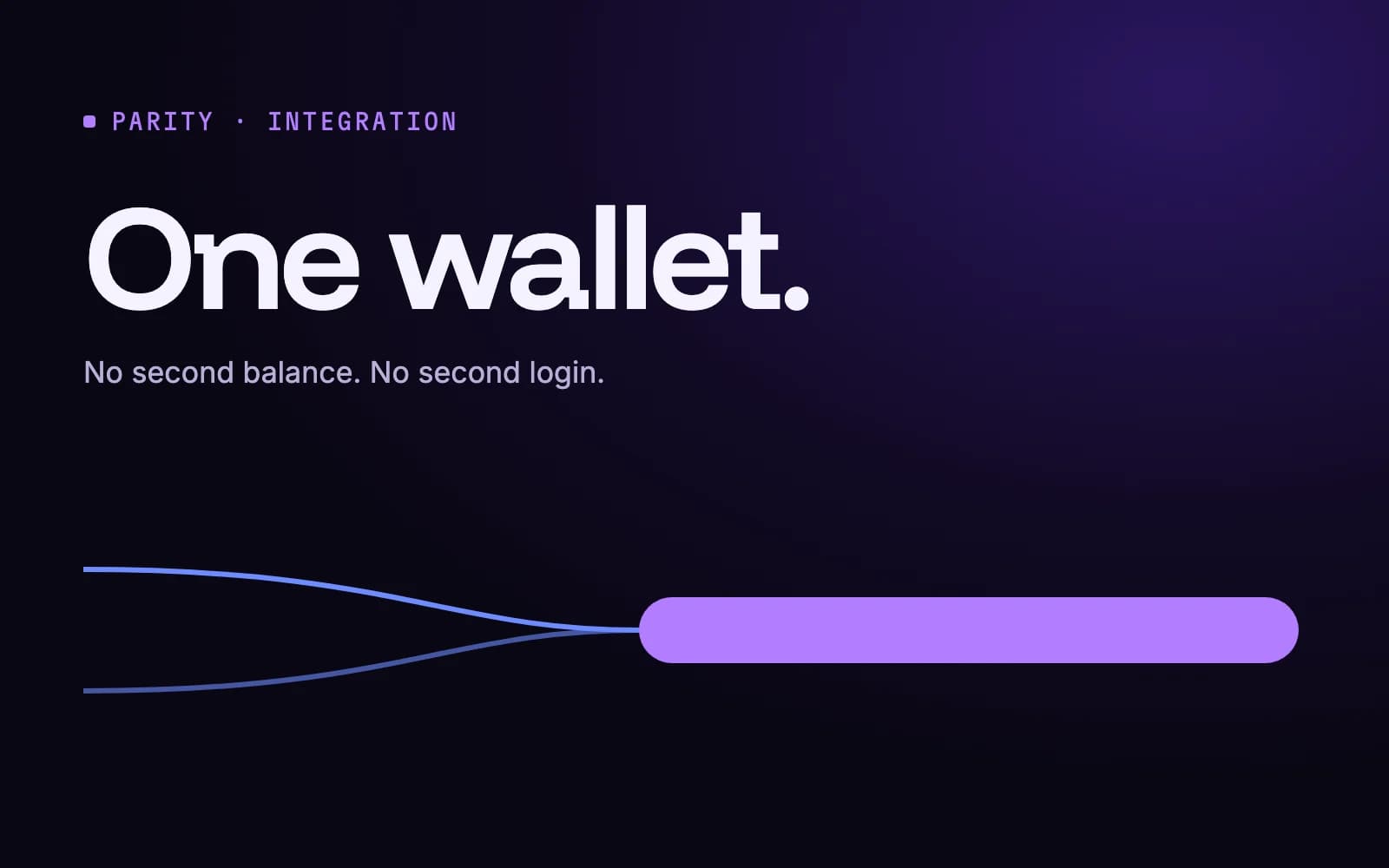
The fastest way to lose a customer to a new vertical is to ask them to fund a second balance. Prediction markets should move money on the ledger you already run, and nowhere else.
In this article 4 sections
Many ways of adding a new product to a gaming platform start with a second wallet: the customer moves money from the main balance into the new one, plays, and moves it back. Every one of those steps is a place to lose them. The transfer screen is friction, the second balance is a second thing to reconcile, and responsible-gaming limits now have two pots to watch.
What a second balance costs you
- Customer friction
- A transfer step before the first trade, and a stranded balance afterwards that the customer has to remember to bring home.
- Two sets of books
- Every movement exists twice, and finance spends its time proving the two agree instead of reading one ledger.
- Split controls
- Deposit limits, loss limits and self-exclusion were built around one balance. A second one is a gap in each of them.
- Custody questions
- If a provider holds the second balance, it is holding your customers’ money, and that changes the regulatory conversation.
How Parity keeps it to one wallet
Parity never holds your customer funds. Your wallet stays the single authoritative balance, and Parity returns the exact amounts to reserve, debit, release and credit as decimal strings. Your ledger applies them, and Parity is told only whether the reserve succeeded. There is no transfer step and no Parity withdrawal screen.
In practice: a customer with $100 who stakes $25 on a market still has one balance of $100, with $75 available and $25 reserved. If the order fills, your ledger debits it. If it does not, your ledger releases it. When the market resolves, a settlement record arrives at your webhook and your ledger credits the payout.
Settlement that lands exactly once
The settlement webhook is signed and retried, and safe to apply twice without paying a customer twice. Beside it sit two reconciliation endpoints, a point-in-time statement and an append-only feed, so your finance team can prove at any moment that your books and Parity's agree and explain any payout months later.
What stays exactly where it is
The account, the sign-in, KYC, deposit and withdrawal, responsible-gaming controls and the support relationship all stay with you. Parity never authenticates your customers and never contacts them. Stakes are shown in your operator's display currency, so the customer sees the same money in the new vertical as everywhere else in your product. House Money runs prediction markets on its own casino wallet this way.
The custody model is set out in full in the money documentation, and embedded prediction markets shows the rest of the responsibility split. For what else your team does and does not build, see adding prediction markets without a rebuild.