How to add prediction markets to a sportsbook
A prediction market is not a new sport for your traders to price. It is a different product with a different risk shape, and the integration that respects that difference is small: a session, a surface and a settlement webhook.
In this article 8 sections
The quickest way to get prediction markets wrong in a sportsbook is to treat them as another sport: a new feed for the traders to price, a new set of fixtures for the grading team, a new line on the risk report. They are none of those things, and an integration built as though they were ends up larger than the product it is delivering.
Start from what is different
A sportsbook prices its own line, holds the other side of it and grades it from a results feed. A prediction market differs on every one of those points, and the differences are what make it cheap to add.
- The price
- A matched price between participants, expressed as cents on a one-dollar contract. It moves because someone traded, not because a trader moved it, and the fee is stated separately rather than carried inside the number.
- The risk
- Parity does not warehouse event risk, and your desk is not asked to price an election or a rate decision. Revenue sits on the transaction and platform layer rather than on a hold percentage.
- The position
- Not a slip that waits for the final whistle. A position with a live price, marked continuously, which the customer can exit before resolution at a market price.
- The settlement
- A published resolution attached to the contract, on rules the customer can read before trading. Nothing new arrives at your grading operation.
Your customers already combine outcomes
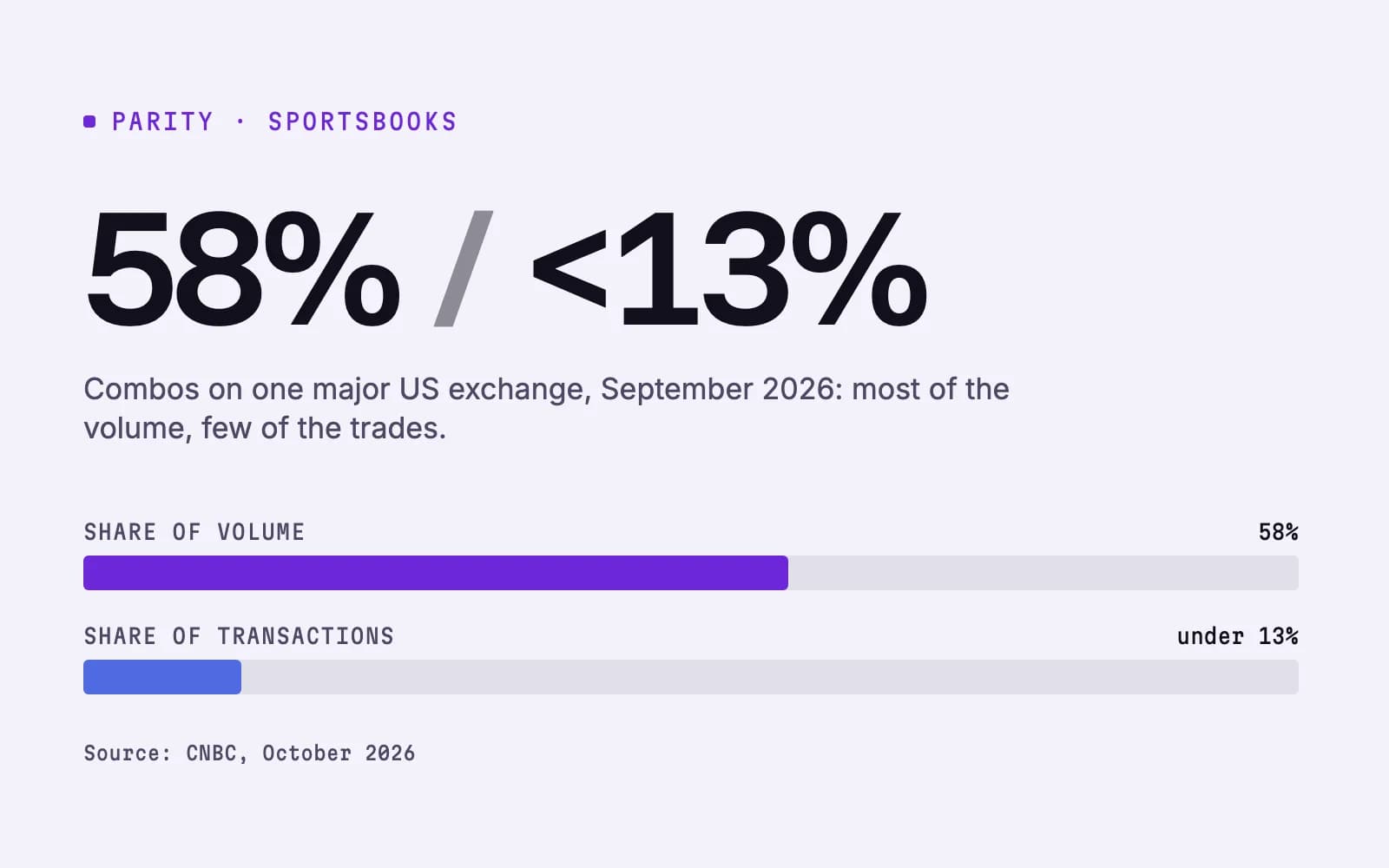
The bet your customers like most is already a prediction about several things at once. In Illinois, parlays took 31.2% of all sports wagering handle in 2025 and 61.5% of the books' gross revenue.1 Prediction exchanges are seeing the same habit: on one major US exchange, combos made up 58% of trading volume in September 2026, but under 13% of transactions.2 In a book, parlays earn far more than their share of the stakes. On an exchange, combos carry far more volume than their share of the trades.
Combined bets
Combined bets carry the money, not the ticket count
Parlays in Illinois sportsbooks in 2025, and combos on one major US prediction exchange in September 2026.
| Measure | Share |
|---|---|
| Illinois 2025: parlays, share of handle | 31.2% |
| Illinois 2025: parlays, share of gross revenue | 61.5% |
| Prediction exchange, September 2026: combos, share of trading volume | 58% |
| Prediction exchange, September 2026: combos, share of transactions | under 13% |
That is why combos are next on Parity, and in preview today on a practice board. Prediction market combos sets out how they work.
What you already have, and should not build twice
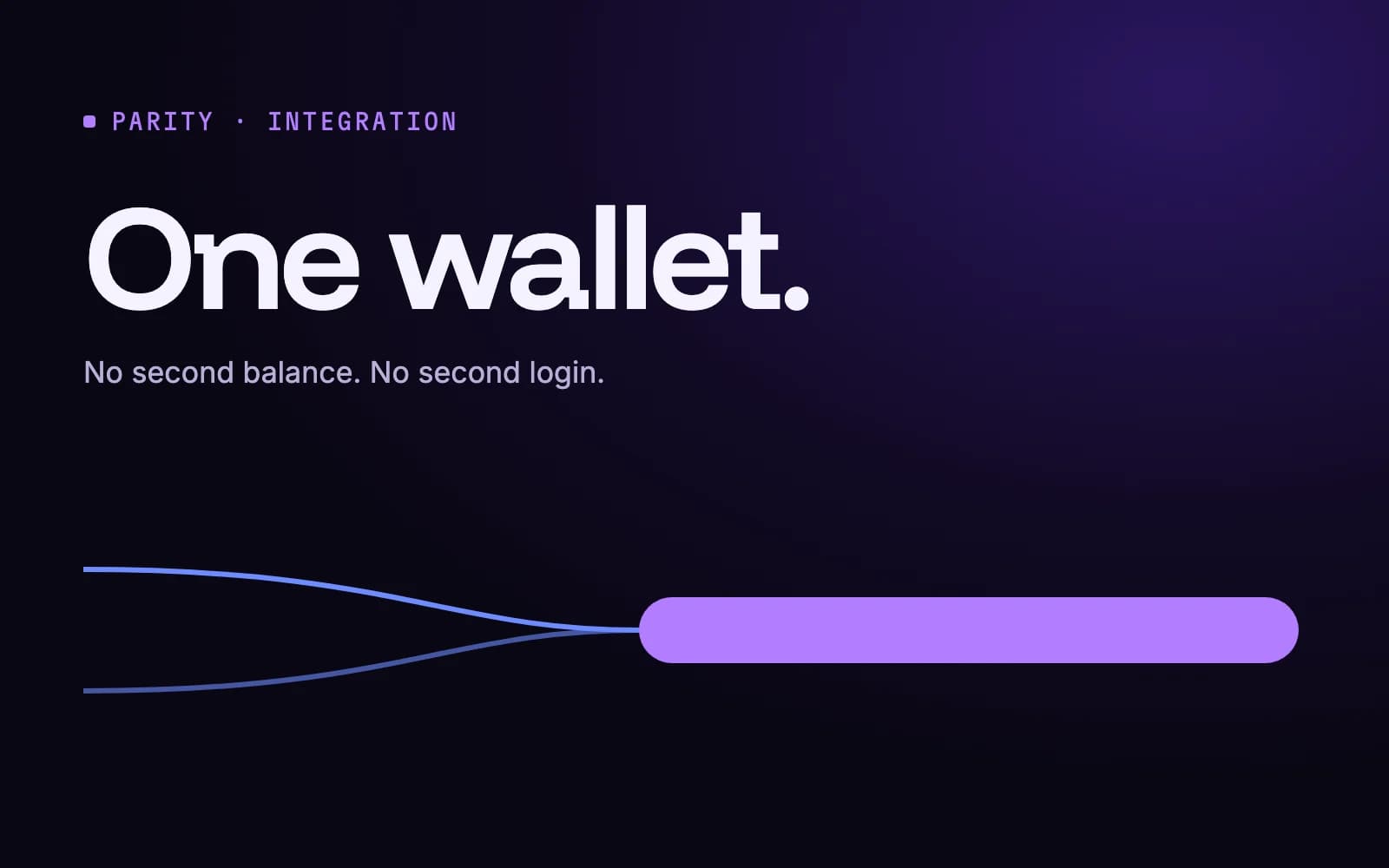
You hold the parts that are expensive to acquire: a licence, a KYC pipeline, a wallet, a responsible-gaming programme, a support team and a customer who is already signed in. A prediction-markets integration should reuse every one of them. If a provider asks you to open a second balance or a second account for the same customer, the integration has stopped being a feature of your sportsbook and become a separate product sitting next to it.
What the integration actually is
With an embedded surface, your team builds three things and none of them is a market.
- A session endpoint
- One server-to-server call, made after your own sign-in has decided who the customer is, that exchanges your user for a browser-safe token. Parity never authenticates the customer and never sees a credential.
- The surface and a listener
- An iframe on the origins you register, and a message listener on your page. Parity draws the market list, the ticket and the positions; your page receives the events that ask your ledger to act.
- A settlement webhook
- Settlement records pushed to your endpoint, signed and retried, safe to apply twice without paying a customer twice.
If your front-end team would rather render the product themselves, the same account drives the API directly: list the catalogue, take a quote, submit the order against it, read the position, receive settlement. The boundary does not move between the two shapes.
Where the money moves
Your wallet stays the single authoritative balance. A customer with $100 who stakes $25 on a market still has one balance of $100: $75 available and $25 reserved. Parity returns the exact amounts to reserve, debit, release and credit as decimal strings, your ledger applies them, and Parity is told only whether the reserve succeeded. There is no transfer step and no Parity withdrawal screen.
Deciding what your customers see
A sportsbook will have firm views about which markets belong next to its own book. Those views are configuration, not a code change. Offering rules are set per operator, by category and by region, and can narrow further for an individual customer, and the same rule is enforced on the catalogue, the quote and the order. A market you are not offered is never sent to the frame rather than sent and hidden.
The rules apply what you write about your own licence. They do not encode any law, and where the final allocation of KYC, custody and regulatory responsibility falls is a commercial and legal question per jurisdiction. That conversation belongs at the start of the project, not at the end.
Settlement without a grading operation
When an event resolves, the outcome comes from its published resolution rather than from a result your team keys in. It becomes a settlement record delivered to your webhook, and two reconciliation endpoints sit beside it: a point-in-time statement and an append-only feed, so you can prove your books and ours agree at any moment and explain any payout months later.
What to ask any provider
Is the price my customer sees the price they can trade at? What happens to an order when the market moves between the quote and the fill? Who holds the customer's funds? Can I keep a category off my surface entirely, and is that enforced when an order is placed, not only when a list is drawn? And when a market settles, how does the record reach my ledger exactly once?
Those are the questions our prediction market platform for sportsbooks is written to answer. White label prediction markets covers what of the surface carries your brand, what a B2B prediction market provider should own sets out the division of work, and the prediction market API is the shape for teams that render it themselves.
References
- 1Illinois Gaming Board. Sports Wagering Reports: Completed Events Sport Detail (accrual), calendar years 2021 to 2025. Accessed 9 October 2026.
- 2CNBC. How event contract bundles are boosting volume on prediction markets. Published 6 October 2026.