Crypto markets
Crypto prediction markets, on the wallet your players already have.
Questions about Bitcoin, Ethereum and Solana, priced in cents on a one-dollar contract and offered inside your own product. Your player takes a position on the price without holding the asset, funding a wallet or leaving your app.
The proposition
The one price a general audience already checks.
Crypto is the rare subject where a mainstream player already holds a view and already looks at the number several times a day. Most products give them a chart and stop there. What they do not have, inside the app they are already signed into, is anywhere to act on the opinion they arrived with.
A prediction market is that somewhere, and it is a genuinely different wagering shape from the rest of your inventory: priced by a market rather than set by a house, held as a position that can be closed before it resolves, and settled against a published number the player can go and check for themselves.
It is also the simplest crypto product you can put in front of a mainstream audience. There is no leverage to explain, no liquidation price, no seed phrase, no network fee and no asset to safeguard. The player picks a side, sees the price and sees the payout before they commit.
One question, two legs, a price in cents.
Every crypto market resolves to one of a small number of named outcomes, and each outcome carries a price in cents. A contract pays a dollar if its outcome happens and nothing if it does not, so the price reads as the market's own odds without a conversion table.
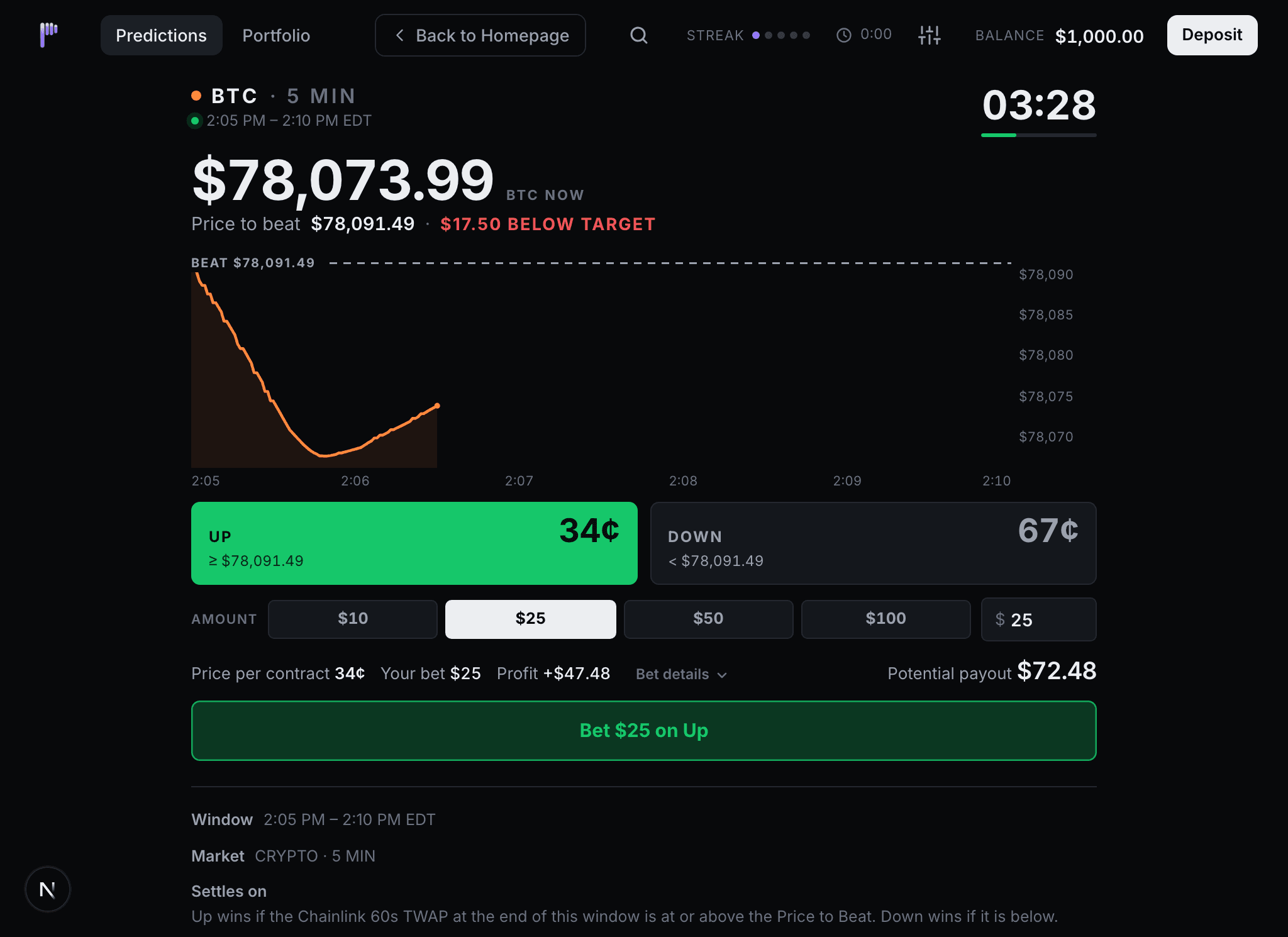
The ticket states the price per contract, the stake, the fee and the payout before anything is committed, and the position it opens is marked continuously afterwards. A player who changes their mind can exit at a market price rather than at a figure the house chose to offer them.
The whole surface is Parity's to build and maintain, on your colours. What you get covers what arrives with the integration.
Two speeds
A crypto catalogue, and a five-minute clock.
Crypto arrives in your product as two different session shapes, from one integration. They are worth telling apart, because they are found in different ways and they suit different moments.
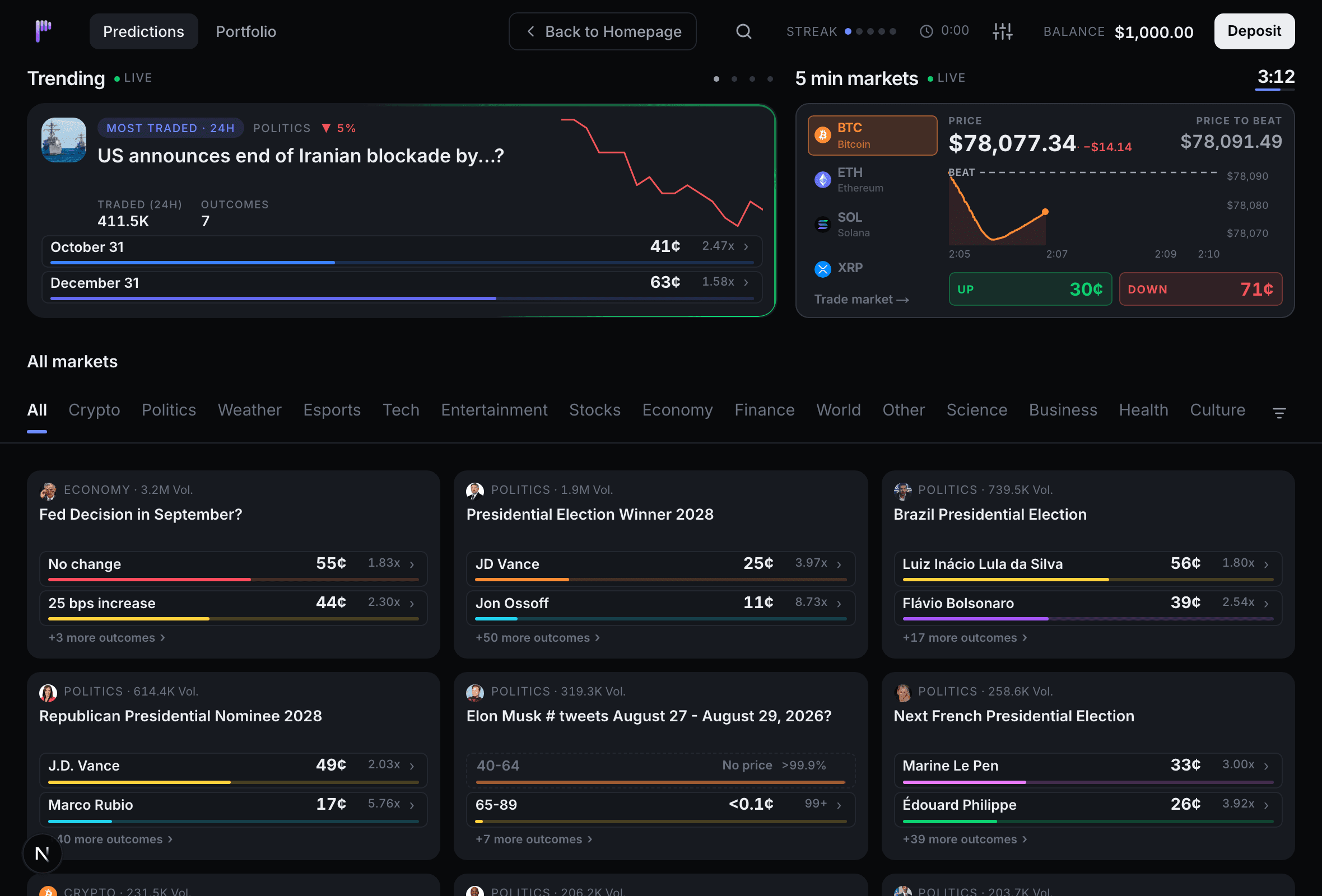
The crypto catalogue
Discovered continuously
- Crypto is one of the player-facing categories, ingested and normalised alongside the rest of the catalogue
- Questions run for days or months, so a position is something a player comes back to
- Priced by the market, with the Parity fee stated separately rather than folded into the number
- Positions are marked continuously and can be exited before the question resolves
Five-minute windows
Computed from a schedule
- Recurring up-or-down windows on Bitcoin, Ethereum and Solana
- Each window is exactly five minutes, aligned to the wall clock on a fixed grid
- Resolved against a published Chainlink 60-second reference price, captured at the open and read again at the close
- The next window is already loaded and priced before the current one closes
The five-minute product exists because a contract that short cannot be found by crawling for it: its whole life is shorter than a single pass over the catalogue. So those windows are not discovered at all. They are arithmetic on a clock, which is what makes them reliable enough to put a countdown on.
Five-minute crypto markets covers that product in full, including how a window settles and which lines are refused as too close to decided.
It sits beside everything else you offer.
Crypto is a category inside a wider catalogue rather than a standalone app, which matters commercially: the player who came for Bitcoin finds elections, macro prints, weather and technology in the same list, and the player who came for those finds crypto.
There are no sports markets in it at all. They are excluded at ingest from the provider's own metadata and never stored, which is why this can sit beside a book instead of competing with one. Prediction markets beside a sportsbook covers that.
You decide who sees the vertical at all. The account, the KYC, the deposits and withdrawals and the responsible-gaming controls stay entirely yours.
On your books
What a crypto category does not add to your operation.
The word crypto usually implies custody, a treasury policy and a compliance conversation about holding an asset. This product implies none of them, and the reasons are worth being specific about.
- No coins, and no custody
- A prediction market is a cash-settled contract on a question, not a spot purchase. A player who takes the Up leg holds contracts priced in cents, not Bitcoin. You never hold, move or account for a crypto asset, your player never funds a wallet or signs a transaction, and nobody on either side needs an exchange account for any of it to work.
- No price feed to run
- The reference price is a published one, and it is the same number the contract settles against rather than a lookalike from somewhere faster. Parity ingests it, streams it to the surface and stamps every observation with the moment it arrived, so a figure the pipeline cannot vouch for disappears instead of sitting there looking current.
- No trading desk pricing coins
- Prices are matched market prices expressed as cents on a one-dollar contract. They move because somebody traded, and Parity passes them through with its fee stated separately rather than folded into the number. Your traders are not being asked to take a view on Bitcoin, because nothing here asks anyone at your company to have one.
- No second wallet, and no second login
- The surface renders inside your product on your brand. Parity returns the exact amounts to reserve, debit, release and credit; you apply them to the one balance you already hold. A player with $100 who stakes $25 still has one balance of $100, with $75 available and $25 reserved.
- No new grading operation
- Settlement follows the outcome the venue publishes, on resolution rules attached to the contract that a player can read before they trade. A resolved event becomes a settlement record delivered to your webhook endpoint, safe to apply twice without paying a customer twice.
Your player takes a position on the price of Bitcoin without ever holding any Bitcoin, and you run the category without ever holding any either.
The full division of responsibility, including what crosses the boundary and what never does, is on embedded prediction markets. If your team would rather render the surface themselves, the API is the other shape, and the developer docs carry every endpoint.
Platform results
What operators see
What the category moves once it is running beside the products an operator already offers. The same figures, and the integration behind them, are on the integration overview.
Adoption
93%
Of 100
The dashed box is the whole
Prediction markets are taken up by the players an operator already has, inside the product they already use.
Lift in volume
15%
Indexed, before = 100
Wagering volume rises once a second reason to open the app sits beside the categories already running.
Reduction in churn
up to30%
Indexed, before = 100
Players with more than one reason to come back leave at a lower rate than players with one.
Parity platform results across operators running prediction markets, recorded at a point in time. Not attributed to any single operator.
Read next
Fast markets
Five-minute crypto markets
Recurring up-or-down windows, a price to beat captured at the open, and a published reference price that decides them.
Read moreGuide
How 5-minute Bitcoin prediction markets work
Why a contract this short is scheduled rather than discovered, and why the price on screen has to be the price that settles it.
Read moreFor operators
Prediction markets for online casinos
The same product argued to the casino side of the house: new inventory on the wallet, brand and licence you already have.
Read morePut crypto markets in front of your players.
Tell us about your platform and your jurisdictions and we will tell you what an integration looks like and what it would take on your side.